I went to high school at an all-male college preparatory school. If you're smart, Catholic and a male St. Louisan, then that is where you go. It was a good place, mostly. Students and families of modest means paid what they could afford. The school seemed to take (and seems to continue to take) affirmative steps to promote racial and economic diversity among the student body.
Coming out as gay in such an environment was absolutely out of the question. The supposed insults of "fag," "homo" etc. were thrown around among the students constantly. All of us ... students, teachers and administrators ... were deliberately indifferent toward it. There is a kind of default environment of hostility among an all-male high school as it is ... I hate to imagine what would have happened to the poor kid who was discovered to be gay.
I also regret my own deliberate indifference to all of the slurs. They contributed to an environment that too often ends up deadly. I was only in my teens, but I should have known better to try and confront this environment in some little way.
Here is a little way.
Showing posts with label politics. Show all posts
Showing posts with label politics. Show all posts
10/11/10

6/10/10
When Politicians Confuse Mean for Median
There's a sixty-year-old theorem called "The Median Voter Theorem." Russel Crowe had a part in inspiring it. The basic idea of the Median Voter Theorem is that, in a head-to-head election, a politician will maximize her votes on election day by adhering to the position of the ideologically median voter in the electorate. Each voter votes for the politician whose ideological position is closest to the individual voter's own position, so finding the median voter is the way to go. You get more votes by "moving to the center."
It's the type of political science theorem that annoys me (for one, it makes for a boring campaign season), but I grudgingly accept it as a winning electoral strategy. I bet that most American politicians of the two major parties pursue this strategy, and that most pursue it quite consciously. It works, but only if it's executed correctly. I think that a lot of politicians fail at the median voter strategy by confusing the mean for the median.
A lot of politicians make the mistake of thinking that they're running for office to represent the state of Platonia. It's kind of a comforting place, this state of Platonia. It's simple, too. With only 11 registered voters. There's a round and even ideological spectrum to it. You can even express each voter's ideological position with a number. 0 = most liberal person ever, while 10 = most conservative person ever.
Platonia Registered Voters and Corresponding Ideological Score (ID)
Median Voter (#6) ID = 5
Mean Voter ID (55/11) = 5
Voter #1 and Voter #11 are incredibly ideological. They're not much for 5 IDs, or even 2 or 8 IDs respectively. They don't vote much, and when they do vote, it's for Lyndon Larouche or somebody like that. Voter #2 and Voter #10 have 1 and 9 IDs, respectively. They like guys like Ralph Nader and Ron Paul, but sometimes they'll vote for the major party candidate if that candidate makes a good case to them, or they perceive that their vote is too important this time around to "throw away." Voter #3 and Voter #9 have IDs of 2 and 8, respectively. Here is the beginning of each major party's base. Still, a certain level of ideological "purity" is required from the candidates to get their vote. Voter #3 cannot stand politicians who behave like they have a 6 ID, and Voter #9 cannot stand politicians who behave like they have a 4 ID. Voter #4 and Voter #8 have IDs of 3 and 7, respectively. Each considers herself a "Democrat" or "Republican" when asked her party affiliation. Each also doesn't perceive the other party's policies as good for her. Voter #5 and Voter #7 each say the he's "independent," but really each almost invariably votes for the same major party over and over again (Democratic and Republican, respectively).
Finally, there is Voter #6. Voter #6 is the median voter. This is the voter up for grabs and the voter that each major party candidate needs to capture in order to win. The closer Voter #6 perceives you to be, the more you maximize your chances at winning.
It's not that difficult to win an election in Platonia. You just need to do and say things that signal to Voter #6 that you have a 5 ID. If you're a Democrat, then you also signal and behave every once in a while in ways that show you have a 2, 3 or 4 ID. But don't act like you have a 6 or 7 ID too much. That will anger your base. You may capture that median voter still, but your base won't vote. It's not hard in Platonia, however. You can act like a 5 and win. And it's easier to act confidently as a 5 because 5 is the mean ideological score of Platonia. The political "climate" is perceived as a 5. The same holds true for a Republican candidate, but in reverse.
The campaigns are boring in the State of Platonia, but professional and effective.
But what about a less ideologically symmetrical state? Let's call this state ... oh, let's say the state of Kansaras. Kansaras, coincidentally, has only 11 registered voters.
Kansaras Registered Voters and Corresponding Ideological Score (ID)
Median Voter (#6) ID = 5
Mean Voter ID (60/11) = 5.45
Compared to Platonia, Kansaras skews toward the conservative side. The mean Voter ID is 5.45 rather than 5. The median voter has a 5 ID, just like the median voter in Platonia.
So, let's say that a politician gets elected to the US Senate to represent Kansaras. He's a Democrat. His name is ... oh ... let's say Lance Blincoln. Senator Blincoln reads the political climate - the mean - correctly as a 5.45 ID. Senator Blincoln decides that by the time he is up for reelection, he should signal to the electorate by word and deed that he himself mostly is 5.45. This way, he will capture the middle.
Senator Blincoln figures that the best and easiest way to signal a 5.45 ID is to take ideological positions that, when averaged out, will put him near 5.45. Senator Blincoln says and does some things that a 3 or 4 would do, but also some things that a 6 or 7 and sometimes even an 8 would say or do. But when you tally-up all of Senator Blincoln's words and acts and divide, it all works out to an ID of 5.45. "Perfect!" thinks Senator Blincoln. "I am on my way to reelection."
But Senator Blincoln is not on his way to reelection. All of those 6 ID and 7 ID positions he's taken have angered the 2 ID and 3 ID voters. It does not matter to them that Senator Blincoln's positions average out to a 5.45 ID. Those 6 and 7 positions are just too much to bear, even if Blincoln has a fair amount of 2ID and 3ID positions to temper them.
Now, let's say that it's primary election time in Kansaras. Let's say that Senator Blincoln gets a primary challenge from another state-wide elected Democratic Lieutenant Governor by the name of ... Jill Walter. Interestingly enough, Jill Walter's ideological ID is the same as Senator Blincoln's: roughly 5.45. The difference is that Lt. Governor Walter's ID was arrived at by taking very few 6 ID positions, and totally avoiding any 7 positions. Most of Lt. Governor Walter's positions are in the high-4 and low-5 range. Lt. Governor Walter knows that the median voter is a 5ID voter, but also that she can't take too many 6 or 7 positions to anger the 2ID and 3ID voters if she wants their support. So, Lt. Governor Walter stays near-exclusively in the range of 4.0 to 5.9. This keeps her close to that median voter without turning-off the 2 and 3 ID voters.
Senator Blincoln can't believe it when he finds that his primary race against Lt. Governor Walter is turning out to be a nail-biter. "What about all of those 3 and 4 ID positions I took?" thinks Senator Blincoln with some consternation. "Have the Democratic voters forgotten? I'm the kind of 'moderate' Democrat that wins general elections in this state. My ID is 5.45: right in the middle. Sheesh!"
Even more perplexing to Senator Blincoln are head-to-head general election polls which show Lt. Governor Walter having a better chance against the likely Republican candidate than Senator Blincoln. "What's the deal? I'm just as much in the middle as Lt. Governor Walter!"
The deal is that Senator Blincoln confused the mean for the median, and confused the Platonia electorate for the Kansaras electorate. The electorate in Kansaras may skew more conservative (or liberal, in the case of Chassamusetts) than Platonia, but it doesn't necessarily follow that the median voter is more conservative (or liberal, in the case of Chassamusetts).
In Platonia, you can hop around more with your ideological positions, and still capture the median voter. If you take some 6 or 7 positions every once in a while, it's less likely to hurt your election or re-election chances. You might lose a 2 or 3 voter here and there, but the other candidate often will do the same on the other side. When the mean and median are the same, you have more lee-way.
But when the mean and median are different, you can't stray too far from either. In fact, the more you stay within the zone between the mean and median, the better. You're going to have to take a fair amount of 3 and 4 positions to keep those voters on your side, but you can't afford to take 6 or 7 positions to "average out" your mean. The 2 and 3 ID voters will decide not to vote for you. Your general election numbers will suffer. You won't win the election, even if your average position turns out to be right in the middle.
Senator Blincoln isn't the only person to make this mistake of confusing the electorate for Platonia's electorate, or confusing the mean for the median. "Conventional Wisdom" pundits make this mistake all the time as well. A politician can't just average-out a bunch of positions and call herself a "moderate," even if it averages out that way. Too many 3s or 7s will turn off the voters you need to win. The pundits may cheer your "principles" or your "maverickiness," but the voters you actually need to win will abandon you, or at least not be very excited about you.
John McCain (who averages-out quite conservative) found this out in 2008, when his high-profile 3ID and 4ID positions came to haunt him. He had to go out and find a solid 9 running-mate just to create some enthusiasm. Arkansas Senator Blanche Lincoln of Arkansas found this out just this Spring. Despite Senator Lincoln's positions "averaging out" quite near the mean and median, many of the regular Democratic voters she depends on for the general election got behind a different candidate in the Democratic primary. The candidate, Bill Halter, is roughly as "moderate" as her. But Halter rarely spoke or acted like a 6, and never like a 7. Halter came extremely close to defeating Lincoln. It took the great example of "5-ness," former President and Arkansan Bill Clinton, to rescue Lincoln by assuring the Democratic electorate of Arkansas that Lincoln was ideologically near them.
Still, Lincoln is likely to lose in the general election this November. It seems that too many regular Democratic voters, those 2s and 3s, will stay home due to Lincoln's 6 and 7 positions.
Whatever one thinks of the Median Voter Theorum as a strategy, it has to be executed moderately for it to work. Averaging out disparate positions to the middle will make you a loser on election night. Pundits may like you, but not voters.
It's the type of political science theorem that annoys me (for one, it makes for a boring campaign season), but I grudgingly accept it as a winning electoral strategy. I bet that most American politicians of the two major parties pursue this strategy, and that most pursue it quite consciously. It works, but only if it's executed correctly. I think that a lot of politicians fail at the median voter strategy by confusing the mean for the median.
A lot of politicians make the mistake of thinking that they're running for office to represent the state of Platonia. It's kind of a comforting place, this state of Platonia. It's simple, too. With only 11 registered voters. There's a round and even ideological spectrum to it. You can even express each voter's ideological position with a number. 0 = most liberal person ever, while 10 = most conservative person ever.
Platonia Registered Voters and Corresponding Ideological Score (ID)
| Voter | 1 | 2 | 3 | 4 | 5 | 6 | 7 | 8 | 9 | 10 | 11 |
| ID | 0 | 1 | 2 | 3 | 4 | 5 | 6 | 7 | 8 | 9 | 10 |
Median Voter (#6) ID = 5
Mean Voter ID (55/11) = 5
Voter #1 and Voter #11 are incredibly ideological. They're not much for 5 IDs, or even 2 or 8 IDs respectively. They don't vote much, and when they do vote, it's for Lyndon Larouche or somebody like that. Voter #2 and Voter #10 have 1 and 9 IDs, respectively. They like guys like Ralph Nader and Ron Paul, but sometimes they'll vote for the major party candidate if that candidate makes a good case to them, or they perceive that their vote is too important this time around to "throw away." Voter #3 and Voter #9 have IDs of 2 and 8, respectively. Here is the beginning of each major party's base. Still, a certain level of ideological "purity" is required from the candidates to get their vote. Voter #3 cannot stand politicians who behave like they have a 6 ID, and Voter #9 cannot stand politicians who behave like they have a 4 ID. Voter #4 and Voter #8 have IDs of 3 and 7, respectively. Each considers herself a "Democrat" or "Republican" when asked her party affiliation. Each also doesn't perceive the other party's policies as good for her. Voter #5 and Voter #7 each say the he's "independent," but really each almost invariably votes for the same major party over and over again (Democratic and Republican, respectively).
Finally, there is Voter #6. Voter #6 is the median voter. This is the voter up for grabs and the voter that each major party candidate needs to capture in order to win. The closer Voter #6 perceives you to be, the more you maximize your chances at winning.
It's not that difficult to win an election in Platonia. You just need to do and say things that signal to Voter #6 that you have a 5 ID. If you're a Democrat, then you also signal and behave every once in a while in ways that show you have a 2, 3 or 4 ID. But don't act like you have a 6 or 7 ID too much. That will anger your base. You may capture that median voter still, but your base won't vote. It's not hard in Platonia, however. You can act like a 5 and win. And it's easier to act confidently as a 5 because 5 is the mean ideological score of Platonia. The political "climate" is perceived as a 5. The same holds true for a Republican candidate, but in reverse.
The campaigns are boring in the State of Platonia, but professional and effective.
But what about a less ideologically symmetrical state? Let's call this state ... oh, let's say the state of Kansaras. Kansaras, coincidentally, has only 11 registered voters.
Kansaras Registered Voters and Corresponding Ideological Score (ID)
| Voter | 1 | 2 | 3 | 4 | 5 | 6 | 7 | 8 | 9 | 10 | 11 |
| ID | 1 | 2 | 3 | 3 | 4 | 5 | 7 | 8 | 8 | 9 | 10 |
Mean Voter ID (60/11) = 5.45
Compared to Platonia, Kansaras skews toward the conservative side. The mean Voter ID is 5.45 rather than 5. The median voter has a 5 ID, just like the median voter in Platonia.
So, let's say that a politician gets elected to the US Senate to represent Kansaras. He's a Democrat. His name is ... oh ... let's say Lance Blincoln. Senator Blincoln reads the political climate - the mean - correctly as a 5.45 ID. Senator Blincoln decides that by the time he is up for reelection, he should signal to the electorate by word and deed that he himself mostly is 5.45. This way, he will capture the middle.
Senator Blincoln figures that the best and easiest way to signal a 5.45 ID is to take ideological positions that, when averaged out, will put him near 5.45. Senator Blincoln says and does some things that a 3 or 4 would do, but also some things that a 6 or 7 and sometimes even an 8 would say or do. But when you tally-up all of Senator Blincoln's words and acts and divide, it all works out to an ID of 5.45. "Perfect!" thinks Senator Blincoln. "I am on my way to reelection."
But Senator Blincoln is not on his way to reelection. All of those 6 ID and 7 ID positions he's taken have angered the 2 ID and 3 ID voters. It does not matter to them that Senator Blincoln's positions average out to a 5.45 ID. Those 6 and 7 positions are just too much to bear, even if Blincoln has a fair amount of 2ID and 3ID positions to temper them.
Now, let's say that it's primary election time in Kansaras. Let's say that Senator Blincoln gets a primary challenge from another state-wide elected Democratic Lieutenant Governor by the name of ... Jill Walter. Interestingly enough, Jill Walter's ideological ID is the same as Senator Blincoln's: roughly 5.45. The difference is that Lt. Governor Walter's ID was arrived at by taking very few 6 ID positions, and totally avoiding any 7 positions. Most of Lt. Governor Walter's positions are in the high-4 and low-5 range. Lt. Governor Walter knows that the median voter is a 5ID voter, but also that she can't take too many 6 or 7 positions to anger the 2ID and 3ID voters if she wants their support. So, Lt. Governor Walter stays near-exclusively in the range of 4.0 to 5.9. This keeps her close to that median voter without turning-off the 2 and 3 ID voters.
Senator Blincoln can't believe it when he finds that his primary race against Lt. Governor Walter is turning out to be a nail-biter. "What about all of those 3 and 4 ID positions I took?" thinks Senator Blincoln with some consternation. "Have the Democratic voters forgotten? I'm the kind of 'moderate' Democrat that wins general elections in this state. My ID is 5.45: right in the middle. Sheesh!"
Even more perplexing to Senator Blincoln are head-to-head general election polls which show Lt. Governor Walter having a better chance against the likely Republican candidate than Senator Blincoln. "What's the deal? I'm just as much in the middle as Lt. Governor Walter!"
The deal is that Senator Blincoln confused the mean for the median, and confused the Platonia electorate for the Kansaras electorate. The electorate in Kansaras may skew more conservative (or liberal, in the case of Chassamusetts) than Platonia, but it doesn't necessarily follow that the median voter is more conservative (or liberal, in the case of Chassamusetts).
In Platonia, you can hop around more with your ideological positions, and still capture the median voter. If you take some 6 or 7 positions every once in a while, it's less likely to hurt your election or re-election chances. You might lose a 2 or 3 voter here and there, but the other candidate often will do the same on the other side. When the mean and median are the same, you have more lee-way.
But when the mean and median are different, you can't stray too far from either. In fact, the more you stay within the zone between the mean and median, the better. You're going to have to take a fair amount of 3 and 4 positions to keep those voters on your side, but you can't afford to take 6 or 7 positions to "average out" your mean. The 2 and 3 ID voters will decide not to vote for you. Your general election numbers will suffer. You won't win the election, even if your average position turns out to be right in the middle.
Senator Blincoln isn't the only person to make this mistake of confusing the electorate for Platonia's electorate, or confusing the mean for the median. "Conventional Wisdom" pundits make this mistake all the time as well. A politician can't just average-out a bunch of positions and call herself a "moderate," even if it averages out that way. Too many 3s or 7s will turn off the voters you need to win. The pundits may cheer your "principles" or your "maverickiness," but the voters you actually need to win will abandon you, or at least not be very excited about you.
John McCain (who averages-out quite conservative) found this out in 2008, when his high-profile 3ID and 4ID positions came to haunt him. He had to go out and find a solid 9 running-mate just to create some enthusiasm. Arkansas Senator Blanche Lincoln of Arkansas found this out just this Spring. Despite Senator Lincoln's positions "averaging out" quite near the mean and median, many of the regular Democratic voters she depends on for the general election got behind a different candidate in the Democratic primary. The candidate, Bill Halter, is roughly as "moderate" as her. But Halter rarely spoke or acted like a 6, and never like a 7. Halter came extremely close to defeating Lincoln. It took the great example of "5-ness," former President and Arkansan Bill Clinton, to rescue Lincoln by assuring the Democratic electorate of Arkansas that Lincoln was ideologically near them.
Still, Lincoln is likely to lose in the general election this November. It seems that too many regular Democratic voters, those 2s and 3s, will stay home due to Lincoln's 6 and 7 positions.
Whatever one thinks of the Median Voter Theorum as a strategy, it has to be executed moderately for it to work. Averaging out disparate positions to the middle will make you a loser on election night. Pundits may like you, but not voters.
6/8/10
Beyond and Behind "Built"
For my foreseeable Facebook future, no more indiscriminate "liking" and no more attempts at
So, here's a thought from a FB friend posted today as her status update:
I can finally enunciate my biggest issue with [St. Louis] "urban affairs" bloggers: their complete focus with the built environment to the exclusion of the social, economic and political environment.I too have a similar thought, and, like my FB friend, I had not been able to articulate that thought until now. I think that the issue goes beyond just the "urbanist" bloggers. The issue goes to how our St. Louis civic culture conceives of our past, our present and our future.
The "urbanist" bloggers who focus on the built environment are incredibly important. It's readily apparent how much they love our city, and want to protect and improve it. Over the past sixty years, many of our city's architectural treasures met their demise from the wrecking ball. Even worse, what came to replace these treasures often were buildings aesthetically horrid and functionally deficient. If our city had a preservationist consciousness over these past sixty years, our city would be a much more beautiful and interesting place to live. The "urbanist" built environment bloggers do important and necessary work in seeking to raise a preservationist consciousness.
So, why does it seem that our city's "urbanist" bloggers focus near-exclusively on built environment? I think it's because notions of built environment are how our city's civic culture conceives of our city. It's a blessing and a curse traceable to our city's largest blessing and curse: the 1904 World's Fair.
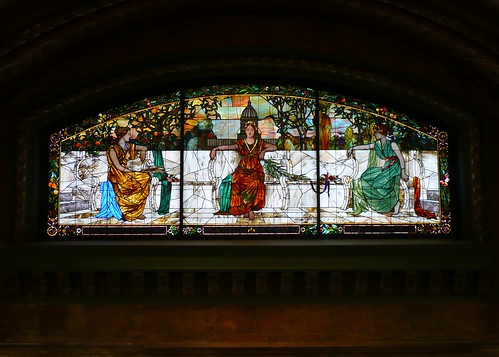
In 1904, St. Louis "welcomed the world." It was a big deal. St. Louis was a big deal. The then-recently-completed Union Station has a stain glass window at the entrance to its Great Hall. The stain glass window depicts, from left-to-right, goddess-like representations of San Francisco, St. Louis and New York. All three in the same league. At the time, this representation wouldn't have elicited even a bemused chuckle. In terms of population and political and economic might, St. Louis was in the same league.
The Fair had an amazing complex of buildings and architecture. After the Fair, all of it was obliterated save for the Art Museum and the Flight Cage. The party was over. Over the years, St. Louis did not keep up with the cities once in its league. Politics and economics kept it largely static. In 2010, the idea of the goddess St. Louis enthroned as an equal of the goddesses San Francisco and New York elicits more than a chuckle.
The Missouri History museum seems singularly obsessed with the World's Fair. There is a perpetual exhibit there, and it takes up an entire wing. Why not be obsessed with the World's Fair? It's incredibly interesting. Most people who live here think it's interesting. It was massive. It was our city's moment of greatness. The vast majority of it is physically gone. It is the ghost of a mighty past haunting Forest Park. All that is tangible of this massive built environment are grainy black-and-white photographs.
In our St. Louis civic collective consciousness, built environment is inextricably linked to prestige. The World's Fair is the best example of this link. The Arch comes in a close second, representative of the high-modernist aspirations of the Sixties. There is a problem with this link. It's not the link per se, but the idea of the causal connection between built environment and civic prestige.
It seems to me that civic health, prestige, community (what have you) manifests itself in the built environment. It further seems to me that often we get this causal link reversed. (I am just as guilty of it as the next person.) We can't help it. Our past glories are manifested in the built environment.
It's incredibly important for us to preserve and celebrate our city's heritage. Each beautiful old building under the shadow of a wrecking ball is more than just a beautiful old building. Each is a manifestation of people's work and dedication ... each is a manifestation of community. Beautiful old buildings should be preserved if they can be preserved.
At the same time, a better understanding and participation in the here-and-now of our city's social, political and economic environment are crucial. Campaigns for preservation often seem to run against the need for jobs in economically-distressed communities. Preservation vs. jobs need not be the oppositional dichotomy. The goal of preserving and creating a healthy built environment first must come from understanding and participating in community. What is it that our community needs, and how do we, as a community, address these needs? The answers won't at first necessarily be physically grand or monumental. Community takes time, and its successes are measured and recognized in the long term. What matters is a sense of investment and a sense of trust.
Finally, it seems to me that we would do well to shed, once and for all, our fixation with the "might" and "grandiosity" of our city's past. I find strains of this fixation among our city's progressive urbanist bloggers (and in my own thinking). This fixation does not serve our city well, for the built environment or otherwise. What will serve our city well is the hard and humble work of community. What will serve this city well are communities engaged and invested in our civic health. What will serve this city well is democracy. Our built environment will manifest how well we serve ourselves.
3/29/10
Cherokee Soundtrack
This April (and as usual these days), several streams come into confluence on Cherokee Street. How gratifying it will be to serve a small part in the confluence.
This past November, I went to check out this place on Cherokee Street called Stirrup Pants. It's a poetry chapbook shop (open for business on Saturdays), and a space for readings. My friend Maggie runs the place. There was a hint of stinging winter chill in the breeze that afternoon, but when I walked into Stirrup Pants I felt nothing but gentle and exuding warmth. I hung out with some great folks, most of whom are affiliated with or related to the Washington University creative writing MFA program. The conversation was relaxed, but not idle. Like a lot of the hanging out lately on Cherokee Street, this was hanging out with a purpose.
I started to attend the readings put on at Stirrup, and met some really great folk. One of the great folk I met is Heather. She runs a reading series called "Exploding Swan." I love that name. For the December edition of the series, Heather recruited my friend Jaffa and I to play some music. I composed a little 10-minute piece - minimalist type music for me on trombone and Jaffa on this reed keyboard and on xaphoon. We performed it at Heather's house for the reading. It seemed to have gone well.
Still another great folk I met through hanging out at Stirrup Pants is Eileen. She teaches at Wash U and works at their Kemper Art Museum. In December, the Kemper had this exhibit of chance art. Eileen put on a free chance aesthetics poetry workshop at the Kemper, complete with free lunch. I went primarily for the free lunch. (Wash U's loaded, so I knew that it would be a good lunch.) The lunch was, in fact, good. The workshop was, in fact, even better. I took away from the workshop two ideas that I have been contemplating ever since. The first idea comes from chance aesthetics' sublimation of the ego. Chance aesthetics often stand for the proposition that art can (and often should) be made not from within the artist's "soul" or even consciousness, but from the artist receiving the material outside herself or himself. The second idea comes from chance aesthetics' necessity for structure. There are always rules or protocols to follow in chance aesthetics. Often the method is the substance, and there must be a method else there will be no pleasing result or construction. Neither of these ideas are new or novel, but both of them are currently embedded in my brain as an approach to musical composition and performance. These ideas also coincidentally related well to the musical group in which I spend the large balance of my time.
I am in a musical group called the Rats & People Motion Picture Orchestra. One of the big things that we do is compose scores and then perform them live to silent films such as F.W. Murnau's Nosferatu or Buster Keaton's Go West. Ideally, we want the audience not to realize that there is a live band playing to the film, or even for the audience to consciously register the music that we're playing. We're secondary to the film, and we compose our scores with that in mind. The idea is not necessarily to respond to the action on the screen, but to complement and support the visual narrative's present mood. Not only to be unseen, but also in a certain sense to be unheard. (Talk about sublimating a performing musician's ego!) There are also real rules and protocols to the music. It is entirely composed. There are very few improvisational moments. Each sound during a 90-minute film is planned. We think that this compositional approach brings about the most pleasing result for the audience.
The Archive is a new & used bookstore that just opened up on Cherokee Street. I attended their grand opening this winter, and found at least a dozen little gems that I hope are still there when I have some money. Like Stirrup Pants, The Archive is a really warm and inviting place full of warm and inviting folk. Authors are coming there from around the country to read and discuss their books. A lot of the authors have written books about localism. Like many businesses on Cherokee, the store also serves as a space for visual art and musical performance. (There's a really nice piano in there.) One of the people who owns and operates The Archive is Mike. Mike's also a film maker. Mike, too, is fascinated with and a big advocate of localism - in what and how we eat, in what and how we are entertained and express ourselves, etc., etc.. Mike's especially fascinated with the co-existence of and interaction between the urban environment and the natural environment. He believes that exploring this relationship between the urban and the natural is a key to creating vibrant and sustainable local urban community. He's kind of on a mission.
Mike made a short film called "Chicken and Waffles." The film documents the raising of three chickens, their slaughter, their preparation, their frying, and their consumption (with waffles) by people. The chickens were raised in the city, slaughtered by people in the city, prepared by people in the city, cooked by people in the city, and consumed (with waffles) by people in the city. It's kind of a how-to manual on localism. Mike filmed the big chicken and waffle cookout at Artica. Artica is this art and music gathering every year on the Mississippi River waterfront - one of those areas where the co-existence of and relationship between the urban and the natural are readily apparent.
This past Winter, Mike asked the R&P MPO to write and to record the musical score and soundtrack for "Chicken and Waffles." This is another big thing that we do, and we happily obliged. We usually record and perform music with very classical and folk influences. Mike asked us to do something with a more heavy rock influence. Again, we happily obliged. We're all former rock musicians, and Mike afforded us the opportunity to scratch a latent itch. The premiere of the finished product is at The Archive on April 6.
Also this past Winter, Heather asked me whether I would compose an R&P MPO piece for the Spring "Exploding Swan" reading series. A really great poet by the name of Zachary Schomburg is coming to town to read at Stirrup Pants. Zach has read to musical accompaniment several times before, and he really enjoys it. There's a group of musicians and poets here in St. Louis called Poetry Scores that records musical accompaniment to spoken word. It's an idea that really fascinates me and that I secretly always wanted to try ... spoken word as melody. Another happy obligation. Another latent itch scratched.
When Zach comes to town on April 14, he'll read selections from a 72-page epic poem he wrote called "Viking." It's about a young man who leaves Earth for Mars, then spends his middle age on Mars, then returns to Earth. When the man returns to Earth, he finds Earth now made of glass. The form remains the same, but the substance now is different ... translucent. I am composing the piece in a way that I hope complements and supports "Viking's" narrative arc. The piece uses just 5 tones: C,D,E,Ab,Bb (e.g. the "form" ... the "rules"). Whether the hero is on earth Earth, Mars, or glass Earth dictates the composed chordal colors derived from the 5 tones (e.g. the "substance" ... the "ego sublimation"). The musical accompaniments to earth Earth and glass Earth will have the same form, but a very different substance. The musical accompaniment for Mars will be similar to Earth's form and substance but just enough different, too.
So ... on Cherokee Street this April, a confluence of ideas, aesthetics, fascinations, missions, form and substance.
Here's hoping that the soundtrack will complement and support.
Movie Night featuring "Chicken and Waffles"
Tuesday, April 6
8 PM
The Archive
3213 Cherokee Street
R&P MPO Accompany Zachary Schomburg
w/ David Weinberg and Jaffa Aharonov
Part of the "Exploding Swan" Reading Series
Wednesday, April 14
8 PM
Stirrup Pants
2122 Cherokee Street
Stirrup Pants http://stirruppants.blogspot.com/
R&P MPO http://www.theratsandpeople.com/mpo.html
The Archive http://www.archivescribe.com/
Zachary Schomburg http://lovelyarc.blogspot.com/
Poetry Scores http://poetryscores.blogspot.com/
This past November, I went to check out this place on Cherokee Street called Stirrup Pants. It's a poetry chapbook shop (open for business on Saturdays), and a space for readings. My friend Maggie runs the place. There was a hint of stinging winter chill in the breeze that afternoon, but when I walked into Stirrup Pants I felt nothing but gentle and exuding warmth. I hung out with some great folks, most of whom are affiliated with or related to the Washington University creative writing MFA program. The conversation was relaxed, but not idle. Like a lot of the hanging out lately on Cherokee Street, this was hanging out with a purpose.
I started to attend the readings put on at Stirrup, and met some really great folk. One of the great folk I met is Heather. She runs a reading series called "Exploding Swan." I love that name. For the December edition of the series, Heather recruited my friend Jaffa and I to play some music. I composed a little 10-minute piece - minimalist type music for me on trombone and Jaffa on this reed keyboard and on xaphoon. We performed it at Heather's house for the reading. It seemed to have gone well.
Still another great folk I met through hanging out at Stirrup Pants is Eileen. She teaches at Wash U and works at their Kemper Art Museum. In December, the Kemper had this exhibit of chance art. Eileen put on a free chance aesthetics poetry workshop at the Kemper, complete with free lunch. I went primarily for the free lunch. (Wash U's loaded, so I knew that it would be a good lunch.) The lunch was, in fact, good. The workshop was, in fact, even better. I took away from the workshop two ideas that I have been contemplating ever since. The first idea comes from chance aesthetics' sublimation of the ego. Chance aesthetics often stand for the proposition that art can (and often should) be made not from within the artist's "soul" or even consciousness, but from the artist receiving the material outside herself or himself. The second idea comes from chance aesthetics' necessity for structure. There are always rules or protocols to follow in chance aesthetics. Often the method is the substance, and there must be a method else there will be no pleasing result or construction. Neither of these ideas are new or novel, but both of them are currently embedded in my brain as an approach to musical composition and performance. These ideas also coincidentally related well to the musical group in which I spend the large balance of my time.
I am in a musical group called the Rats & People Motion Picture Orchestra. One of the big things that we do is compose scores and then perform them live to silent films such as F.W. Murnau's Nosferatu or Buster Keaton's Go West. Ideally, we want the audience not to realize that there is a live band playing to the film, or even for the audience to consciously register the music that we're playing. We're secondary to the film, and we compose our scores with that in mind. The idea is not necessarily to respond to the action on the screen, but to complement and support the visual narrative's present mood. Not only to be unseen, but also in a certain sense to be unheard. (Talk about sublimating a performing musician's ego!) There are also real rules and protocols to the music. It is entirely composed. There are very few improvisational moments. Each sound during a 90-minute film is planned. We think that this compositional approach brings about the most pleasing result for the audience.
The Archive is a new & used bookstore that just opened up on Cherokee Street. I attended their grand opening this winter, and found at least a dozen little gems that I hope are still there when I have some money. Like Stirrup Pants, The Archive is a really warm and inviting place full of warm and inviting folk. Authors are coming there from around the country to read and discuss their books. A lot of the authors have written books about localism. Like many businesses on Cherokee, the store also serves as a space for visual art and musical performance. (There's a really nice piano in there.) One of the people who owns and operates The Archive is Mike. Mike's also a film maker. Mike, too, is fascinated with and a big advocate of localism - in what and how we eat, in what and how we are entertained and express ourselves, etc., etc.. Mike's especially fascinated with the co-existence of and interaction between the urban environment and the natural environment. He believes that exploring this relationship between the urban and the natural is a key to creating vibrant and sustainable local urban community. He's kind of on a mission.
Mike made a short film called "Chicken and Waffles." The film documents the raising of three chickens, their slaughter, their preparation, their frying, and their consumption (with waffles) by people. The chickens were raised in the city, slaughtered by people in the city, prepared by people in the city, cooked by people in the city, and consumed (with waffles) by people in the city. It's kind of a how-to manual on localism. Mike filmed the big chicken and waffle cookout at Artica. Artica is this art and music gathering every year on the Mississippi River waterfront - one of those areas where the co-existence of and relationship between the urban and the natural are readily apparent.
This past Winter, Mike asked the R&P MPO to write and to record the musical score and soundtrack for "Chicken and Waffles." This is another big thing that we do, and we happily obliged. We usually record and perform music with very classical and folk influences. Mike asked us to do something with a more heavy rock influence. Again, we happily obliged. We're all former rock musicians, and Mike afforded us the opportunity to scratch a latent itch. The premiere of the finished product is at The Archive on April 6.
Also this past Winter, Heather asked me whether I would compose an R&P MPO piece for the Spring "Exploding Swan" reading series. A really great poet by the name of Zachary Schomburg is coming to town to read at Stirrup Pants. Zach has read to musical accompaniment several times before, and he really enjoys it. There's a group of musicians and poets here in St. Louis called Poetry Scores that records musical accompaniment to spoken word. It's an idea that really fascinates me and that I secretly always wanted to try ... spoken word as melody. Another happy obligation. Another latent itch scratched.
When Zach comes to town on April 14, he'll read selections from a 72-page epic poem he wrote called "Viking." It's about a young man who leaves Earth for Mars, then spends his middle age on Mars, then returns to Earth. When the man returns to Earth, he finds Earth now made of glass. The form remains the same, but the substance now is different ... translucent. I am composing the piece in a way that I hope complements and supports "Viking's" narrative arc. The piece uses just 5 tones: C,D,E,Ab,Bb (e.g. the "form" ... the "rules"). Whether the hero is on earth Earth, Mars, or glass Earth dictates the composed chordal colors derived from the 5 tones (e.g. the "substance" ... the "ego sublimation"). The musical accompaniments to earth Earth and glass Earth will have the same form, but a very different substance. The musical accompaniment for Mars will be similar to Earth's form and substance but just enough different, too.
So ... on Cherokee Street this April, a confluence of ideas, aesthetics, fascinations, missions, form and substance.
Here's hoping that the soundtrack will complement and support.
Movie Night featuring "Chicken and Waffles"
Tuesday, April 6
8 PM
The Archive
3213 Cherokee Street
R&P MPO Accompany Zachary Schomburg
w/ David Weinberg and Jaffa Aharonov
Part of the "Exploding Swan" Reading Series
Wednesday, April 14
8 PM
Stirrup Pants
2122 Cherokee Street
Stirrup Pants http://stirruppants.blogspot.com/
R&P MPO http://www.theratsandpeople.com/mpo.html
The Archive http://www.archivescribe.com/
Zachary Schomburg http://lovelyarc.blogspot.com/
Poetry Scores http://poetryscores.blogspot.com/
11/27/09
I walked today on Spring Street behind St. Mary's High School past a large abandoned apartment complex. Windows broken and boarded up. It appeared as if the complex was some kind of public or subsidized housing. Across the street from the apartment complex is a corner store called "Speedway" or something like that. Liquor, cigarettes, junk food. I began thinking that the only difference between that corner store and a corner drug dealer is a license.
11/25/09
Here is a rather thorough blog entry from the Atlantic on the cost-control measures in the Senate health insurance reform bill. It's so thorough that apparently the President via Rahm Emmanuel has ordered the White House health care task force staff to read it.
The cost-control measures seem to me pretty solid, but without some competition on the consumer side of things through a public option will these cost controls actually translate to lower premiums and better services?
The cost-control measures seem to me pretty solid, but without some competition on the consumer side of things through a public option will these cost controls actually translate to lower premiums and better services?
11/23/09
Where in the health insurance reform process Josh Marshall sees a dead end, Booman sees a jam.
But without a health insurance reform bill of any kind passing, Congressional Democrats will find themselves in an electoral jam next November.
The Democrats are in a position where passage of a bill is imperative, and it appears to me that if the Progressive Caucus assertively hold their ground then that bill will include a public option. But if four conservative Democratic senators continue to claim that they will filibuster a Senate bill with a public option, then where else can the Senate go but to budget reconciliation? Senatorial courtesies be damned. The Democrats need a bill passed and signed into law or they are assuredly in for discourtesies from the electorate.
But without a health insurance reform bill of any kind passing, Congressional Democrats will find themselves in an electoral jam next November.
On the generic Congressional ballot Democrats lead Republicans 46-38. However, when respondents were asked how they’d vote if a health care bill with a public option was passed, that margin tightened to a 46-41 Democratic lead. The political implications of that though are not nearly as bad as if no health care bill is passed. Asked how they would vote next year under that scenario the generic ballot is tied 40-40 between the two parties.Marshall argues that what's left of the public option at this point in the process is so anemic that perhaps not much really would be lost in jettisoning the public option to secure passage of the overall bill. Still, there are significant amounts of Representatives (many in the "Progressive Caucus") who claim that a bill without a public option means that they will not vote "Aye" after Conference Committee. These are mostly members of Congress representing super-safe Democratic districts, and would very likely not lose their seats due to no bill being passed. They are well leveraged. A bill without a public option could very well be in danger of not passing as one with a public option, however anemic.
The Democrats are in a position where passage of a bill is imperative, and it appears to me that if the Progressive Caucus assertively hold their ground then that bill will include a public option. But if four conservative Democratic senators continue to claim that they will filibuster a Senate bill with a public option, then where else can the Senate go but to budget reconciliation? Senatorial courtesies be damned. The Democrats need a bill passed and signed into law or they are assuredly in for discourtesies from the electorate.
11/20/09
My Republican friend Tory (everybody should have at least a couple, right?) emailed me about my take on his former Dartmouth instructor Jeff Smith. Here is my response:
Hey Tory! How's AZ?
The whole thing is really sad. I mean, he deserves to go to prison, because he basically had a million chances to come clean but instead he lied to federal investigators and (worst of all) very explicitly counseled and encouraged other people to lie. That's a classic obstruction conspiracy. If he had come clean about it from the get-go, there would have been a hefty fine that his campaign committee would have payed, and that fine (and a little embarrassment) likely would have been the end of it. For goodness sake ... every campaign gets hit with these fines and they're considered to be basically the cost of doing business. (I think I read that both Obama's and McCain's campaigns had fines numbering in the hundreds.)
There are two sad things about it.
First, just about everybody in Jeff City - of all political stripes and persuasions - thought of Jeff Smith as one of the most talented, hard-working and intelligent legislators around. I don't want to be harsh, but the large majority of the folks up there - of both parties - are complete doofuses. It's a real loss for our state.
Second, Jeff Smith's state senate district geographically is about half-white and half-black. Unlike a lot of politicians representing St. Louis City districts with this kind of segregation, he really worked hard at representing and serving the entirety of his district. People on both sides of town liked and trusted him. His behavior undermines a lot of good work he did to begin uniting our city.
The silver lining, if there is one, is that I think a lot of people still do like and trust him. He seems genuinely contrite about what he did. Maybe he could make a comeback. I likely would vote for him if he did.
-matt
My new hero:
“I made a decision at the beginning that the experts wrecked this economy and the public has a right to know what’s going on,” she said. “It’s our economy on the line and the experts can’t be trusted. I want everyone to be part of the solution to how we want to change our economic world. If it’s risky or makes me look stupid to someone, so be it.”
11/18/09
11/13/09
I agree with this, but if you are eighteen, smart and minimally motivated then everybody tells you it is your only option. Due to the lack of alternative avenues to success, it often is the only option.
Looking back, I sometimes wish I had waited a couple of years after high school and then attended a public institution. The older I get, the more I think that four-year liberal arts colleges are a kind of racket.
Looking back, I sometimes wish I had waited a couple of years after high school and then attended a public institution. The older I get, the more I think that four-year liberal arts colleges are a kind of racket.
11/12/09
11/11/09
11/10/09
11/7/09
11/4/09
Though this video montage of Fox News' breathless coverage of NY-23 is meant to be a kind of sad trombone directed at the losers, it's illustrative of the fact that the Tea Partiers are not some kind of sua sponte grassroots movement of the disgruntled but rather a well-coordinated, well-funded and top-down organization. Dick Armey and his crew run the political side while NewsCorp and its crew handle the communications side. They lost NY-23, but they're likely to get better.
LG&M breaks down last night's odd-year election results, and sees turnout and Tip O'Neill's adage of "all politics is local" as determinative. Core Democratic groups such as young people, minorities and low-income people stayed home. The winning candidates ran campaigns better tailored to local concerns. I would not be surprised if the insurgent conservative candidate in NY-23, Doug Hoffman, lost votes due to perceptions that he was an outsider backed largely by outside elements (Sarah Palin, Dick Armey, et al). Upstate New York may be conservative, but not that kind of conservative.
I watched the Obama campaign documentary on HBO last night. I thought that it was kind of uneven. A little too much fawning at times, and not enough of the true behind-the-scenes moments that make The War Room so good. Still, it's worth a watch. What I took from the film is the calm and discipline of Obama's inner circle, especially Axelrod and Plouffe. They are such a contrast to Carville and Stephanopoulos in The War Room. Different campaigns in different times call for different people, I suppose.
I watched the Obama campaign documentary on HBO last night. I thought that it was kind of uneven. A little too much fawning at times, and not enough of the true behind-the-scenes moments that make The War Room so good. Still, it's worth a watch. What I took from the film is the calm and discipline of Obama's inner circle, especially Axelrod and Plouffe. They are such a contrast to Carville and Stephanopoulos in The War Room. Different campaigns in different times call for different people, I suppose.
11/3/09
It is election day today in some places. New Jersey and Virginia elect governors. NY-23 elects a new member of Congress. Nate Silver writes about the state of the GOP brand in all of these places.
The NY-23 race must have given pollsters fits. Tea Party-backed conservative insurgent Doug Hoffmann appeared to have a slight plurality lead over both moderate Republican Dede Scozzafava and conservative Democrat Bill Owens. This weekend on my way to Nashville I heard on the radio that Scozzafava dropped out. I figured that she got the push in order for the vote not to be split, which would raise a real possibility of a Democrat occupying a seat that has been Republican since like 1850. I thought wrong. GOP former-candidate Scozzafava endorsed Democrat Bill Owens. Now nobody has any clue what's going to happen today. How many Scozzafava supporters will now support Owens? What will turnout look like in general? Every pollster mapping and following this race is in the dark.
Adding to the NY-23 circus is a kind of proxy war between national elements of the hard-right and the soft-right of the GOP. There are even bestiality jokes a-flyin'.
Most polls of the New Jersey Governor's race show a dead-heat between incumbent Democrat Jon Corzine and GOP challenger Chris Christie. Independent Chris Daggett pulls in about 8% of the vote. It seems that every cycle New Jersey looks poised to elect a GOP governor but then it does not pan out. I'll believe it when I see it. Corzine has a huge war chest and a genuine get-out-the-vote operation crucial in close elections. President Obama is making direct appeals to the Democratic base on radio and television on behalf of Corzine. I think that Corzine will have just enough to squeak by to victory. Still, the amount of corruption scandals in New Jersey and consequent anti-incumbency feelings among the NJ electorate should not be underestimated. If I were a betting man and this was a horse-race, I'd take Republican Christie because the pay-out would be better on the odds.
Virginia reprises what for me is its role as the national battleground (see here, and here). Perhaps 2008's biggest coup for the national Democrats was winning Virginia in the presidential race. A Democratic Virginia breaks the back of any GOP victory coalition. While Virginia has elected Democratic governors of late, it appears as if Republican Bob McDonnell is poised for victory. Republicans are smart to push McDonnell as a 2012 presidential candidate. Virginia is crucial to any Republican presidential victory, and having a native son at the top of the ticket could pull the Commonwealth back into the Republican column three years from now.
And if that's not enough election stuff for you, this is on tonight:
The NY-23 race must have given pollsters fits. Tea Party-backed conservative insurgent Doug Hoffmann appeared to have a slight plurality lead over both moderate Republican Dede Scozzafava and conservative Democrat Bill Owens. This weekend on my way to Nashville I heard on the radio that Scozzafava dropped out. I figured that she got the push in order for the vote not to be split, which would raise a real possibility of a Democrat occupying a seat that has been Republican since like 1850. I thought wrong. GOP former-candidate Scozzafava endorsed Democrat Bill Owens. Now nobody has any clue what's going to happen today. How many Scozzafava supporters will now support Owens? What will turnout look like in general? Every pollster mapping and following this race is in the dark.
Adding to the NY-23 circus is a kind of proxy war between national elements of the hard-right and the soft-right of the GOP. There are even bestiality jokes a-flyin'.
Most polls of the New Jersey Governor's race show a dead-heat between incumbent Democrat Jon Corzine and GOP challenger Chris Christie. Independent Chris Daggett pulls in about 8% of the vote. It seems that every cycle New Jersey looks poised to elect a GOP governor but then it does not pan out. I'll believe it when I see it. Corzine has a huge war chest and a genuine get-out-the-vote operation crucial in close elections. President Obama is making direct appeals to the Democratic base on radio and television on behalf of Corzine. I think that Corzine will have just enough to squeak by to victory. Still, the amount of corruption scandals in New Jersey and consequent anti-incumbency feelings among the NJ electorate should not be underestimated. If I were a betting man and this was a horse-race, I'd take Republican Christie because the pay-out would be better on the odds.
Virginia reprises what for me is its role as the national battleground (see here, and here). Perhaps 2008's biggest coup for the national Democrats was winning Virginia in the presidential race. A Democratic Virginia breaks the back of any GOP victory coalition. While Virginia has elected Democratic governors of late, it appears as if Republican Bob McDonnell is poised for victory. Republicans are smart to push McDonnell as a 2012 presidential candidate. Virginia is crucial to any Republican presidential victory, and having a native son at the top of the ticket could pull the Commonwealth back into the Republican column three years from now.
And if that's not enough election stuff for you, this is on tonight:
10/29/09
Why are American soldiers in Afghanistan? To what end are they dying? When will their mission be accomplished? Honestly, I have no idea. The whole situation looks to me more and more like this.
10/23/09
Subscribe to:
Posts (Atom)