For my foreseeable Facebook future, no more indiscriminate "liking" and no more attempts at
So, here's a thought from a FB friend posted today as her status update:
I can finally enunciate my biggest issue with [St. Louis] "urban affairs" bloggers: their complete focus with the built environment to the exclusion of the social, economic and political environment.I too have a similar thought, and, like my FB friend, I had not been able to articulate that thought until now. I think that the issue goes beyond just the "urbanist" bloggers. The issue goes to how our St. Louis civic culture conceives of our past, our present and our future.
The "urbanist" bloggers who focus on the built environment are incredibly important. It's readily apparent how much they love our city, and want to protect and improve it. Over the past sixty years, many of our city's architectural treasures met their demise from the wrecking ball. Even worse, what came to replace these treasures often were buildings aesthetically horrid and functionally deficient. If our city had a preservationist consciousness over these past sixty years, our city would be a much more beautiful and interesting place to live. The "urbanist" built environment bloggers do important and necessary work in seeking to raise a preservationist consciousness.
So, why does it seem that our city's "urbanist" bloggers focus near-exclusively on built environment? I think it's because notions of built environment are how our city's civic culture conceives of our city. It's a blessing and a curse traceable to our city's largest blessing and curse: the 1904 World's Fair.
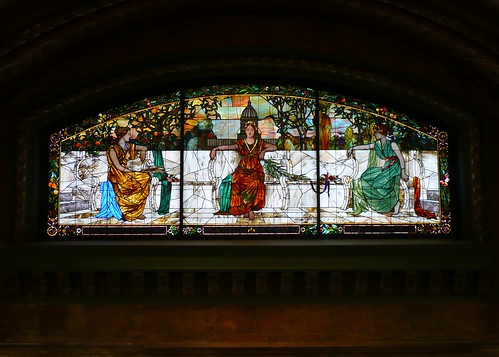
In 1904, St. Louis "welcomed the world." It was a big deal. St. Louis was a big deal. The then-recently-completed Union Station has a stain glass window at the entrance to its Great Hall. The stain glass window depicts, from left-to-right, goddess-like representations of San Francisco, St. Louis and New York. All three in the same league. At the time, this representation wouldn't have elicited even a bemused chuckle. In terms of population and political and economic might, St. Louis was in the same league.
The Fair had an amazing complex of buildings and architecture. After the Fair, all of it was obliterated save for the Art Museum and the Flight Cage. The party was over. Over the years, St. Louis did not keep up with the cities once in its league. Politics and economics kept it largely static. In 2010, the idea of the goddess St. Louis enthroned as an equal of the goddesses San Francisco and New York elicits more than a chuckle.
The Missouri History museum seems singularly obsessed with the World's Fair. There is a perpetual exhibit there, and it takes up an entire wing. Why not be obsessed with the World's Fair? It's incredibly interesting. Most people who live here think it's interesting. It was massive. It was our city's moment of greatness. The vast majority of it is physically gone. It is the ghost of a mighty past haunting Forest Park. All that is tangible of this massive built environment are grainy black-and-white photographs.
In our St. Louis civic collective consciousness, built environment is inextricably linked to prestige. The World's Fair is the best example of this link. The Arch comes in a close second, representative of the high-modernist aspirations of the Sixties. There is a problem with this link. It's not the link per se, but the idea of the causal connection between built environment and civic prestige.
It seems to me that civic health, prestige, community (what have you) manifests itself in the built environment. It further seems to me that often we get this causal link reversed. (I am just as guilty of it as the next person.) We can't help it. Our past glories are manifested in the built environment.
It's incredibly important for us to preserve and celebrate our city's heritage. Each beautiful old building under the shadow of a wrecking ball is more than just a beautiful old building. Each is a manifestation of people's work and dedication ... each is a manifestation of community. Beautiful old buildings should be preserved if they can be preserved.
At the same time, a better understanding and participation in the here-and-now of our city's social, political and economic environment are crucial. Campaigns for preservation often seem to run against the need for jobs in economically-distressed communities. Preservation vs. jobs need not be the oppositional dichotomy. The goal of preserving and creating a healthy built environment first must come from understanding and participating in community. What is it that our community needs, and how do we, as a community, address these needs? The answers won't at first necessarily be physically grand or monumental. Community takes time, and its successes are measured and recognized in the long term. What matters is a sense of investment and a sense of trust.
Finally, it seems to me that we would do well to shed, once and for all, our fixation with the "might" and "grandiosity" of our city's past. I find strains of this fixation among our city's progressive urbanist bloggers (and in my own thinking). This fixation does not serve our city well, for the built environment or otherwise. What will serve our city well is the hard and humble work of community. What will serve this city well are communities engaged and invested in our civic health. What will serve this city well is democracy. Our built environment will manifest how well we serve ourselves.